The Mark of Athena… and my shaky nerves.

Wisdom's daughter

“True success requires sacrifice.” Words spoken by the goddess Nemesis — surely, this is a bad sign!

The Mark of Athena demonstrates Rick Riordan’s increasingly suspenseful and exhilarating story-telling for the Heroes of Olympus… although I also keep wondering how much longer it’ll be until one of them bites the dust. There are just so many bad omens, foreshadowing of terrible things to come, and the ever-present “nothing ever goes well for a demigod” mentality.

Nonetheless, it is so wonderful to see Percy and Annabeth together at last. (I am finally able to officially join Team Percabeth!) From the moment the Argo II reaches Camp Jupiter, to the last excruciating moments of the story, my heart aches for them both. Yet, the development of each character’s personality, as well as the relationships between them, blossom throughout their quest. Cooperation between the seven chosen demigods is not only essential to their survival, but truly what helps them maintain the urgency of the quest — and prevents any of them from abandoning ship (which is often very, very tempting). As they try to escape the Roman legions of Camp Jupiter, aim to get rid of creepy eidolons, battle against Phorcys and Kato, try to avoid the various traps set for them, and search for clues to follow the Mark of Athena before setting sail for Rome (where things will only get exponentially worse!), the heroes need to rely on each other and learn that they are not only trustworthy, but valuable members of this quest.

Granted, it can’t be easy to carry so much power on one ship, no matter how grandiose the Argo II is. Percy and Jason constantly clash as leaders, since boys will be boys, and they want to out-macho each other. Frank fears Hazel’s interest in Leo, his short life-expentancy, and overall awkwardness. Hazel simply wants to feel useful due to this being her second shot of a meaningful life. Leo wants to desperately prove himself while keeping the trireme together, and trying to fit in with the group… he is quite uneasy about being the odd man out. Piper is cursed with that blade of bad news, Katoptris, so her nerves are always on edge. Annabeth is stretched so thin between ensuring the group holds together, and worrying about her own solo quest… the one no child of Athena has ever completed, and the one she must suffer alone. However, Coach Hedge is having a fantastic time… screaming out “Die!” every chance he gets. He is the much needed comic relief.

As I read my way through this group’s most difficult quest to date — riding along with Percy, Annabeth, Jason, Piper, Frank, Hazel, Leo, and Coach Hedge — I appreciated the references to prior adventures and previous books. These characters all have so much history — some more than others, but even the newest of crew members are invaluable at this point. Remember when Percy first awoke to hearing Annabeth say “you drool in your sleep”?… or how they took turns unwillingly holding up the sky?… or how Percy gave up the chance at immortality to be with Annabeth?

(… and where is Grover?!)

Of course, this all brings me back to the overwhelming amount of bad omens, and the many promises made that will no doubt be broken in the near future. I fear it can really go either way for our beloved heroes: perhaps a hero’s path is never easy, but after so much struggle and heartache, are they not deserving of some rewards at the end? …. or perhaps it’s all just horror after horror, and there’s a good reason why the Greeks invented tragedies.

Leave a comment

Filed under Book Review, fantasy, Mythology, Young Adult

Percy’s Back!! … as The Son of Neptune

poseidon's trident

I am really liking this whole Roman aspect of the gods… but mostly, I love that Percy’s back! I missed him. Another thing I loved: his entire memory is wiped, but he remembers Annabeth’s name… and that is enough. Rick Riordan knows how to show some appreciation for Percy’s adoring fans.

Percy is at his most impressive in The Son of Neptune. The story begins as he battles two comical gorgons in Bargain Mart greeter vests, who carry some poisonous discount snacks — I must admit, I developed a soft spot for Stheno. He carries “old hippy-lady / Juno” across a highway — where he meets my new favorite demigods, Hazel Levesque (daughter of Hades) and Frank Zhang (… with quite the extraordinary heritage, even for a demigod) — across the Tiber River, and into Camp Jupiter. Here he is able to show off his vast power over water, crushing the gorgons, and saving Frank’s life. Finally, Juno reveals that horrible things are about to happen, and so they will need Percy. During the camp’s version of capture-the-flag, the 5th cohort (Percy’s new group and laughingstock of the camp) pulls off a tremendous win, causing Ares — I mean, Mars — to show himself and present the plucky trio with a prophecy and a quest. Granted, his prophesy is not as mysterious and rhyme-y as we are accustomed, but it gets the job done: “Go to Alaska. Find Thanatos. Come back by sundown on June twenty-fourth or die.” Did I mention Thanatos/Death has been captured… thus, the bad guys just won’t die?

This is one of the best adventures for Percy so far! There is humor, heart, action, all kinds of monsters, Roman myths, and suspense through the entire quest. Each character has such a rich backstory — it’s great to see some characters resurfacing, like Hylla as Queen of the Amazons. As a reader, I felt so invested in Hazel and Frank’s need to prove themselves, to help the camp, to defeat and conquer all challenges thrown their way because of their inner turmoil, troubled history, as well as sense of integrity and loyalty toward their friends — after all, these friends are the only family they have left. Even the most dislikable gods seem more reasonable and personable throughout this quest. I think we can all agree that Hera is truly the unfriendliest deity when it comes to demigods — as the goddess of marriage, I suppose we can understand why she loathes the mortal children of the gods… but it’s not like it’s their fault! Yet, as Juno, she is the only Olympian making a real effort to ensure the safety and longevity of her family: gods and demigods alike. I remember Ares quite vividly in The Lightning Thief… and I can understand why Percy hated him so much. Yet as Mars, he has much more depth — he reads The Art of War, he has a sense of duty, he foretells succinct prophecies, he doesn’t believe in senseless wars — he may not be my favorite Olympian, but I wouldn’t call him the worst either.

After seeing Percy demonstrate his daunting battle skills, reliving Hazel’s past in New Orleans and Alaska, and experiencing Frank’s doubts about being able to pull his own weight as a member of this monumental expedition, I couldn’t keep my hopes from going beyond the completion of the quest and wishing for the best possible outcome for all heroes involved. But prophecies never end well… I have so many questions, concerns, and suspicions: I don’t trust Octavian… I worry he’s so much more than a lame augur who enjoys disemboweling  teddy bears and beanie babies. I wonder about Reyna and Jason… and Piper. I fear whatever it is Juno hints at about Annabeth…

It’s enough to keep me reading for a good while longer.

Leave a comment

Filed under Book Review, fantasy, Mythology, Young Adult

The Lost Hero …and brushing up on Roman Mythology

Festus and Prophecy

The Lost Hero by Rick Riordan continues the story of teenage demigods who battle mythological forces to save the world from complete annihilation. I loved and devoured the Percy Jackson quintet:

1) The Lightning Thief

2) The Sea of Monsters

3) The Titan’s Curse

4) The Battle of the Labyrinth

5) The Last Olympian

.. and they were all wonderfully entertaining! I really enjoyed recalling my Greek mythology, and cheering for Percy as his journey transformed the troubled kid in Yancey Academy to the awesome hero of Camp Half Blood (and all of Western Civilization, really). Thus my surprise when The Lost Hero, which should continue the epic adventures of this magnificent band of demigods has… well, no Percy! Nonetheless, I understand that this is meant to start a whole new quest with different characters, and the story is told from a different angle. My Roman mythology background is not as sharp as my understanding of the Greeks, hence, I need to brush up on a couple of myths.

The story begins with confusion: Jason doesn’t know who he is, he’s not sure where he is, he doesn’t know who his friends are, and he’s calling everything by its Roman name… oh, and he’s supposed to be dead. But he has some great friends: Piper, daughter of Aphrodite, and Leo, son of Hephaestus — despite the fact that they don’t actually know him, and have trouble fitting into their own lives, they band together to save Hera… the unfriendliest of the gods. Of course, trouble ensues, secrets are discovered, the world is in danger all over again… but I still enjoyed watching the relationships develop, and having each character achieve a certain level of success and self-confidence. Who doesn’t root for the underdog?

I like that although the mythological universe of The Lost Hero is a familiar one, the story is somewhat different. I’m not sure how I feel about Jason… he’s great, he’s a born leader, he’s tough and strong, and despite some self-doubt, he’s just so perfect… but he’s no Percy Jackson.

So I’m looking forward to reading The Son of Neptune… I am very concerned for how things will fare for Percy without his memories to keep him out of trouble!

Leave a comment

Filed under Book Review, fantasy, Mythology, Young Adult

Hollow City: The Peculiar Tale Continues…

London

Hollow City by Ransom Riggs is the second novel in the tale of Ms. Peregrine’s time traveling troupe of peculiarly gifted children.

Here are a couple of terms and notes that I found to be rather useful in making sense of this rather odd tale while reading:

Ymbryne: female keepers of the loops and caretakers of peculiar children.

Wights: bad guys with no pupils who feed peculiar children to the hollows.

Hollows: invisible tentacled monsters who devour peculiar children… and anything else that allows itself to be eaten, really.

Loop: a place hidden within a time warp that repeats the same day over and over again.

Also, it helps to keep track of the children and their peculiar abilities:

Jacob: he can see and sense hollows.

Emma: she can create fire from her hands without getting burned.

Hugh: he can communicate with bees, and keeps them safe inside his stomach.

Claire: she has two mouths…

Olive: she floats; needs special weighted shoes to keep her on the ground.

Bronwyn: she is incredibly strong.

Horace: he is able to dream of the future (as in bad omens and such).

Millard: he’s invisible.

Enoch: he can bring inanimate objects (and in some cases, dead people) back to life.

Fiona: she grows things… very quickly.

Hollow City picks up right where Miss Peregrine’s Home for Peculiar Children leaves off: on a couple of precarious boats crossing from the island of Cairnholm to the mainland of Wales. The survivors — Jacob, Emma, Hugh, Claire, Olive, Bronwyn, Horace, Millard, Enoch, and Fiona… oh, and the bird — of the wights’ and hollows’ vicious attack on their loop, set out to find another ymbryne who can help get Ms. Peregrine back into her human form. The children miraculously make it through a storm and onto the mainland, only to be are chased by wights. As they run through the forest and read peculiar fairytales (because how else are they to keep calm at this chaotic time?!), they discover that the hollows have found a way to enter loops — they couldn’t do that before… that’s why loops are supposed to be a form of safe haven for peculiars. But now that wights and hollows have captured the ymbrynes, discovered how to get into these hidden loops, and have a master plan for world domination, how are a bunch of kids and a bird to survive?

…and then things get weird.

They meet some strange animals within Ms. Wren’s loop. It’s a menagerie with an emu-raffe, a talking dog, a odd monkey-man, and chickens who lay exploding eggs (among other creatures). They’re equipped with all kinds of items and head off for 1940s London. But not before meeting some gypsies — contact with the peculiar children does not bode well for the gypsies once they are questioned by the wights. So basically, it’s bad upon bad — then they meet some new peculiars — more bad things happen — and then they meet some carny folk — and then it gets worse… but through a streak of sheer luck and happenstance, they make it to a frozen building where they realize that things are even worse than they imagine in a world-wide scale across time. I hope I’m painting an appropriately grim picture without giving anything away…

“Strange, I thought, how you can be living your dreams and your nightmares are the very same time.”

The story just keeps getting curiouser and curiouser — but you keep reading because you simply need to know what oddity will happen next. However, as with any good story, there are emotions, true bonds, and thought-provoking questions at its core. These children have been through so much; most of them have been abused, abandoned, and mistreated for being freaks of nature. It’s no wonder they would go through hell and back for Ms. Peregrine, risking their lives in the process. Yet, for Jacob it’s a different driving force altogether — he sought out Ms. Peregrine to learn about his grandfather, but leaving a loving family and life behind is much more than he could possibly owe any one of his companions. He goes along with them because of his sense of duty, feelings of camaraderie, and love for Emma.

From the very beginning of the story, the children have a mission: to save Ms. Peregrine. But as the story goes on, as they being to realize that there’s a bigger problem, one must wonder: what happens next? Whether they can save Ms. Peregrine or not, the truth of the matter is that the ymbrynes have been captured, peculiars are being hunted, everyone’s courage is being tested — so, who’s going to help? Who takes a stand to protect those being persecuted? Who’s going to save the peculiar world? It’s particularly poignant that a large part of this take takes place during World War II. Considering the chaos of the world at this point in history, and how so many people were senselessly killed because they were… different, we can see how Ransom Riggs develops the idea that someone needs to step up. But saving the world is too much for such a rag-tag group of misfits to take on — which begs the question: if not them, then who? It’s a difficult decision, but one that must be made. And considering that Jacob is the only one who can see and sense the hollows, how far will he go for his new friends? How much can he sacrifice for them?

The events at the end of Hollow City are… exciting, to say the least. It is clear that there is so much more to this story — the mythology of peculiars is just getting started, and things are going to get a lot worse before they get any better.

“At the heart of nature’s mystery lies another mystery.”

… this is one mystery I look forward to reading more about.

Leave a comment

Filed under Book Review, fantasy, Science Fiction, Young Adult

The Infinite Sea… of Anger and Frustration

chess pieces

“He promised he would empty me. He would empty me and fill me with hate. But he broke that promise. He didn’t fill me with hate. He filled me with hope.”

… And if you’ve had a chance to read The 5th Wave, hope is death — but hope is all humanity has when it’s lost everything else that matters. The Infinite Sea by Rick Yancey picks up right where The 5th Wave leaves off. Everyone is injured, sleep-deprived, on edge, and hopeful, while shacked up in a crumbling hotel being overrun with rats. Once again we are able to experience the events as they unfold through the eyes of different characters, and even learn the backstory of Ringer and Poundcake. Cassie is hoping against all odds that Evan is alive and able to meet them at their rendezvous, Ben hopes Ringer is able to explore some caves that could be their winter shelter since they can’t stay in the rat-infested hotel for much longer, everyone else hopes Ben will survive his injuries and infected bullet wound. There’s plenty of hope and wishful thinking to go around. “No hope without faith, no faith without hope, no love without trust, no trust without love. Remove one and the entire human house of cards collapses.” So which one will be taken away? How to the Others plan to dismantle human existence and wipe it from the face of the planet? And most importantly, why are they being so methodical and cruel about it?

Anger. Frustration. Anxiety. Manipulation. I felt all these things as I kept on reading hoping to find some answers, hoping certain troublesome events would be resolved, hoping I would find out more about these sadistic aliens, and hoping things would be okay in the end, hoping there was indeed something to hope for. It’s the end of humanity as we know it, and I wanted things to be okay. I know…

Through Ringer’s experience we are able to learn more about the Others, their evil master plan, and their reasoning behind the attack on humanity — it’s all a rather confusing riddle, which only adds to the questions and frustration. Rick Yancey’s style is also deeply brooding and existential — but how else would we react when faced with the finality of our lives and extinction of our entire race? Each person is constantly faced with a choice of life or death — a choice that decides not only what happens next, but how their character and identity and collective consciousness of all of humanity will be defined. To kill? To die? To leave behind? To risk your life? To give up? To keep going? To break down and cry? To be strong and hold on? To trust? To suspect? To live? To love? To hope?

I read most of this book in one very long sitting because I needed answers. But what kept me reading was the feeling of experiencing it all first hand — all of my emotions matched those of Cassie and Ringer and Ben. Yancey chooses carefully how he presents information to the reader… and at times I felt I was being toyed with — Is he being cryptic on purpose? Is he messing with my head? Is he trying to throw me off? How could this be? Should I have seen this coming? … What I definitely saw coming was that I wouldn’t get all of my answers by the end of this book. I have a million more questions…

“You never know when the truth will come home. You can’t choose the time. The time chooses you.”

I cannot wait for the third installment of this trilogy.

Leave a comment

Filed under Book Review, Science Fiction, Young Adult

The 5th Wave — Not Your Average Little Green Men

evan walker

It’s such a great experience to discover you enjoy something you normally wouldn’t have considered. For example, I wouldn’t normally pick up a book about an alien invasion… and yet, I couldn’t put Rick Yancey’s The 5th Wave down!

The varying points of view add a certain dimension to the story-telling as we are introduced to, first and foremost, “Cassie for Cassiopeia” and her family. She gives us the crash tour through the waves: “1st wave, lights out”– an EMP makes all electricity and technology useless… “2nd wave, surf’s up” — a massive tsunami wipes out all coastal cities… “3rd wave, pestilence” — the “blood plague” carried by birds wipes out anyone not immune… “4th wave, Silencers” — alien-infested marksmen shoot off the living… and the “5th wave”… well, that’s what it’s all about, isn’t it? As the waves go on, the human count dwindles. Through each section we see the different points of views — How are each of our characters affected by this apocalyptic event? How does each one deal with loss? How can anyone go on living? What truly matters?

The question at the heart of it all, “How do you rid the Earth of humans? Rid the humans of their humanity.”

While Cassie grapples with the promise she makes to her little brother Sammy, Ben struggles with the regret of running away, and Evan battles with… being good at what he does — (his job is not that pleasant) — the events for total human extinction are moving fast. With the world in complete and utter chaos, paranoia takes over: there is no trust. Trust = death. “First rule: Trust no one. The only way to stay alive as long as possible is to stay alone as long as possible.” Secondly, give up hope — because the end is inevitably coming, and it’s not a matter of “if” but “when.” Thus, hope = death; “That will kill you. It kills you before die. Long before you die.” As the awful and carefully calculated events unfold, pessimism and realism blur their undefinable borders… but our characters keep on going. They find strength within their humanity to go on, to defy the ever-so-slim odds, and finally converge at the point of complete chaos.

And so, although the driving forces behind this sci-fi story are the cataclysmic events, the fast action, and the nail-biting suspense — it’s the meaningful bonds between characters that keep you reading. Whether it’s the way Sammy clings to Ben (and vice versa), or the way Evan clings to Cassie (and vice versa) — it’s the human element that matters most when life on the planet barely matters at all. It may be that “the harder survival becomes, the more you want to pull together. And the more you want to pull together, the harder survival becomes.” But the truth is… that this what we humans do: in times of crisis, we pull together.

Of course, there’s also that Cassie is a hilarious narrator… and then there’s also Evan Walker. Just… Evan Walker.

I will be reading The Infinite Sea now…

Leave a comment

Filed under Book Review, Science Fiction, Young Adult

The Rise of a Villain — Sorting My Emotions About Marie Lu’s The Young Elites

young elites 2

The Young Elites by Marie Lu is a wonderfully imaginative novel with so many layers of story-telling intertwined. Lu creates a world with three moons, and tells us the story of Adelina Amouteru, who lives on an island where the Inquisition chases after the malfettos — children scourged by a horrible blood fever that leaves them marked and with special abilities. She creates poetry, history, literary quotes, ancient gods, and the mythology that lies behind this elaborate tale. But most importantly, she creates complex characters and action-packed scenes that drive the story forward, pulling you in, forcing you to turn the pages as quickly as possible just see what happens next.

Adelina is a tortured soul — and I wanted to root for her every step of the way. But the poor girl is broken, beaten, and deeply disturbed. She has the makings of a very powerful villain… I just wanted to see her succeed so badly. My denial almost made me miss all the signs. She loses her mother to the blood fever, she is unloved and mistreated by her awful father, she’s sold off as a mistress, watches her father being trampled to death by a horse, is imprisoned and sentenced to death by burning at the stake… and this is all within the first few pages of the book! She is raised to feel… insufficient — her beauty is marred by her grey hair and missing eye; she is temperamental, yet eager to please; she is constantly compared (by herself and others) to her beautiful and affable little sister, Violetta. She’s bound to snap. “Soon you’re going to see that things don’t end well for everyone. Some of us are broken and there’s nothing you can do to fix it.”

Yet it is her affinity toward dark emotions that strengthen her. She basks in fear and anger and danger. She is one twisted sixteen-year-old, for sure. But she also wants to belong, she wants to be loved, she wants to be accepted by friends — she simply wants people who will be kind to her without expecting something in return. There is so much loss for Adelina, so much fear of trusting others — so much desire to hurt others as she’s been hurt in return.

“I am Adelina Amouteru… I belong to no one. On this night, I swear to you that I will rise above everything you’ve ever taught me. I will become a force that this world has never known. I will come into such power that none will dare hurt me again.”

Clearly, she means business. As we read her story, empathize with her insecurities, cower along with her in deep dark corners, root for her when things finally start to go right… only to watch them unravel bit by bit… we understand, why to become an unstoppable force, Adelina must suffer, and pull from the darkness of her life the ability to inflict pain upon others.

Leave a comment

Filed under Book Review, fantasy, Young Adult

“You disappoint me,” she whispered.

the stars

I loved reading this book. I cannot praise Kate DiCamillo’s talent enough for weaving such details into a story and creating such beautiful characters. Edward Tulane starts out as the perfect little self-centered porcelain bunny rabbit. At the beginning his word is just so… exact. But Pellegrina sees that he disappoints — a little girl’s bunny rabbit should love that little girl just as much as she loves him. But Edward doesn’t love anyone… he cares only about himself. So he must go out into the world… his heart must be broken… he must suffer and constantly leave without saying goodbye… only then, does he learn to love.

Those stars which he finds so comforting at the beginning of the story, don’t care the slightest bit about him when he’s out alone in a field of crows! “I have been loved,” poor little Edward cries pathetically into the night… “So?” is the stars’ reply. It’s quite befitting that the book opens with a quote from “The Testing Tree,” by Stanley Kunitz: “The heart breaks and breaks / and lives by breaking. / It is necessary to go / through dark and deeper dark / and not to turn.” Edward’s heart learns to break again and again — he loses Abilene when he falls overboard, he loses Nellie when he is thrown into the garbage by her daughter, he loses Bull and Lucy when they are thrown off the train, he loses Sara Ruth when she dies, and he loses Bryce who loves him so much he cannot leave him a broken heap of porcelain…

Oh, Edward’s heart does indeed break and break — and as a reader, my heart broke with him. But it’s only through breaking that Edward learns to live and to love and to appreciate those around him. Do we truly only learn through loss? Is it only suffering that shapes the best of us? Is it the stumbles and mistakes and heartbreaks that makes us lovably imperfect?

In any case, I am happy this little bunny, scrapes and all, found his way home again.

Leave a comment

Filed under Book Review, fantasy

Hope: The Elephant in the Room?

magician's elephant

“But what if?

Why not?

Could it be?”

Kate DiCamillo’s novel about The Magician’s Elephant is so beautifully written… the only way this story would not pull at your heartstrings is if you genuinely do not have any. Each character has their own story, each one searches for their own happiness, and each one is in desperate need of hope.

At first, the story seemed like a mystery to me — with Peter asking the fortune teller about his sister… does she live? And the fortuneteller’s cryptic answer, “You must follow the elephant… she will lead you there.” But as the characters’ stories unfold, and their deepest desires are exposed to the reader, it’s not so much a mystery as a quest to believe the impossible can come true even in the most hopeless of circumstances.

To the town of Baltese, this elephant that drops out of thin air is a symbol of the impossible coming true. Yet, to the magician, it is but an act of desperation: “Yes, the magician had intended to conjure lilies. But standing on the stage of the Bliffendorf Opera House, before an audience that was indifferent to whatever small diversion he might perform and was waiting only for him to exit and for the real magic to begin, the magician was struck suddenly, and quite forcibly, with the notion that he had wasted his life.” Desperate times may call for desperate measures, after all. Don’t we all wish we could conjure up an elephant when we’re in need of a little appreciation? The magician’s predicament feels quite personal to me — there is such a disconnect between what he intends, and what he actually accomplishes. Though he intends to conjure lilies, his inability to follow through with his intensions haunts him for most of the story… until he can set it right again. But for those of us without magic, how do we set things right again?

The other characters also have conflicting views of this magical elephant: to Peter, “an elephant was a ridiculous answer to any question — but a particularly ridiculous answer to a question posed by the human heart.” To the countess Quintet, the elephant is a status symbol and owning the most coveted animal in town, a reason to have extravagant parties. To Leo Matienne, the elephant is a good omen, but his wife Gloria cannot be so optimistic: “My heart has been broken too many times, and it cannot bear to hear your foolish questions.” Yet, there they were… “what if? … why not? … could it be?” The incessant questions of a hopeful heart — who can silence them? Isn’t that why we want to believe in hope? Isn’t it why we want to believe in magic?

“‘But that is impossible,’ said Peter.

‘Magic is always impossible,’ said the magician. ‘It begins with the impossible and ends with the impossible and is impossible in between. That is why it is magic.'”

Simple enough, right?

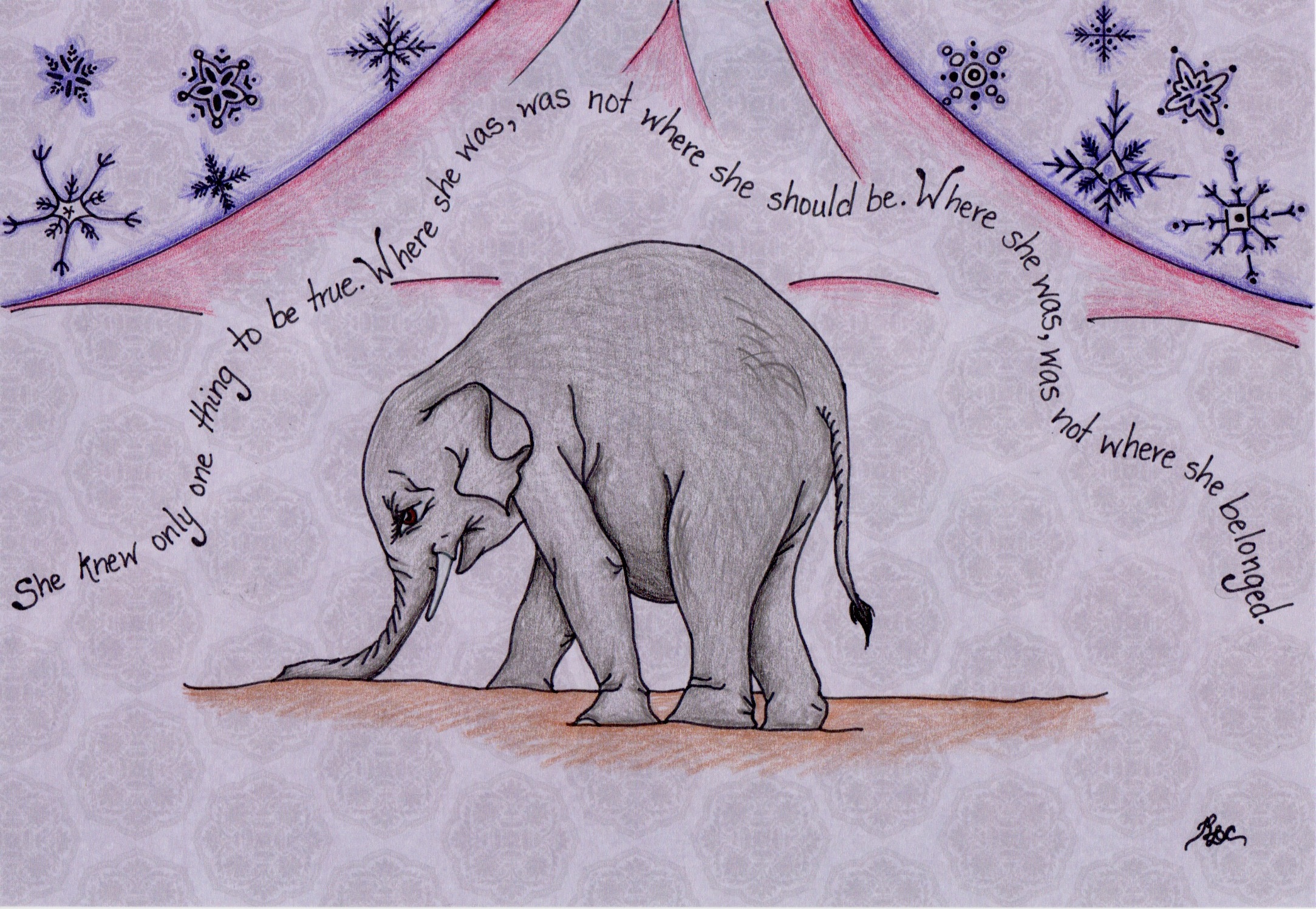
Meanwhile, the elephant herself… she suffers so. “It was hard for her to breathe; the world seemed too small. […] Deep within herself, the elephant said this name, her name, over and over again. She was working to remind herself of who she was. She was working to remember that, somewhere, in another place entirely, she was known and loved.” She is out of place. She is unhappy. She is desperate to make her reality a different one. But she is the elephant in the room — locked away so that the town can line up to see the magician’s greatest accomplishment — only Peter truly sees her. Just as he knows how important family is to him, he can see deep within her soul that she needs to go back to her family as well.

In the end, it’s not so much that everyone is looking for hope… but that everyone is hoping for love. The magician needs admiration, Leo Matienne and Gloria need a child, Peter needs his sister, the elephant needs to go home… the town needs a reminder: “It is a bad thing to have love and nowhere to put it.”

And that’s the magic… how do we channel our love, our passion, and our happiness into a worthwhile endeavor? I’m not sure… it seems like it’s impossible all around and in between.

… But what if?

Leave a comment

Filed under Book Review, fable

The Existential Rats of NIMH

mazes and roses

“The cage was my home for a long time. It was not uncomfortable… Yet just the fact it was a cage made it horrible… [but] by teaching us how to read, they had taught us how to get away.”

It is impossible not to instantly fall in love with a rat that spends his life musing so deeply about the most significant matters of existence. Although the tale of these field rodents revolves around Mrs. Frisby and her children, it is clearly Nicodemus who steals the spotlight.

While being held captive at The National Institute of Mental Health (NIMH), Nicodemus and his friends struggle with a gamut of emotions: fear for their lives, uncertainty over their fate from day to day, hope for their freedom… it is, of course, hope that keeps them going through the electrified maze, despite the depressing realization that only a metal gate awaits at its end. It is the illusion that at some point freedom can be attained that pushes them to explore their surroundings, keep track of the scientists’ routines, and finally leads them out into the world. However, it is learning to read that truly changes these rats’ destiny. Reading… “using symbols to suggest a picture or an idea. From that time on it gradually became clear to me what these lessons were for, and once I understood the idea, I was eager to learn more.” It is reading that provides both the way out and the way to a more complicated existence.

“The real point is this: We don’t know where to go because we don’t know what we are… Where does a group of civilized rats fit in?” Being different, being self-aware, and being eager to learn made these rats a new breed… it made them want more out of life, and it made Nicodemus in particular wonder and worry “about the fact that whatever we ate, whatever we needed, must always be stolen. Rats had always lived that way. And yet — why?” There is that tiny yet powerful question… WHY? Why steal what isn’t theirs to take? Why live as thieves when they are such intelligent creatures? Why scrounge off society when they could be useful and self-sustaining instead?

To feed their curiosity and thirst for knowledge, the rats read within the study of a temporarily vacant home. Nicodemus learns about what he calls “the People Race” — since “the Rat Race” has nothing to do with rats at all– ” a race where, no matter how fast you run, you don’t get anywhere.” The rats were stuck in a rut — life had become too easy: they could steal food, electricity, tools, water, even air! A lack of work made the rats far too complacent in their lethargic existence. “We did not have enough work to do because a thief’s life is always based on somebody else’s work.” This is what bothered Nicodemus: the rats enjoyed the fruits of someone else’ labor while doing nothing for themselves. Sadly, thievery and laziness are not the grounds upon which great civilizations are built. A hard choice that to be made, and thus, The Plan came into fruition: to live without stealing. Unfortunately, not everyone agreed with Nicodemus’ plan for greatness. Many where perfectly happy and content with living like “fleas on a dog’s back” and doing nothing in exchange for their existence. For instance, Jenner complains about Nicodemus’ idea that “we’ve got to start from nothing and work hard and build a rat civilization.” That was far too much effort to achieve very much the same level of comfortable living — Jenner only cared about the end, but Nicodemus truly valued the means.

Clearly, Robert C. O’Brian drew many parallels between human beings and these fascinating rats. There are those who are aware of their responsibility to society and take pride in their hard work, while there are others perfectly satisfied with contributing nothing and taking as much as possible. Yet he is not pontifical about it — Nicodemus understands that it isn’t laziness that prevents Jenner from buying into his plan, it is his cynicism. Although Jenner and his group of dissenters die electrocuted while trying to steal some tools, it isn’t a moralizing death — after all, it seems Justin dies too while trying to save his friend. Nonetheless, there is a lesson to be learned and questions to be asked: what are we willing to die for? What do we contribute to the world? What do we value? … and lastly, WHY?

Leave a comment

Filed under Book Review, fable, fantasy