
 “It is the responsibility of those who survive the struggle for freedom to give testimony. To tell the story in order to keep alive the memory of those who died.” — Julia Alvarez Julia Alvarez’s writing resonates with those of us who have been through the difficulties of assimilating to American culture, and that awkward in-between experience of fitting in neither here nor there. But in Before We Were Free, she goes a step further to bring to life a different struggle — the one that takes place before assimilation is even an issue… the struggle that causes a family to flee their native land in the first place. She depicts the coming of age of Anita Torres, who must grow up in the midst of a dictatorship, while experiencing the gradual disappearance of her surrounding extended family. Through Anita’s observations and diary entries we learn about cousins who from one second to the next have a plane to catch, an uncle who has been neither seen or heard from for a while, hushed conversations among the adults, a family compound that progressively becomes deserted, a housekeeper’s ominous prophesy that “not everyone can have wings,” as well as Anita’s slow realization that her beautiful country is not as full of the liberties and opportunities she once imagined she possessed.
Although Anita is at first your typical spoiled little girl of privilege, she becomes more complex at the story develops. She uses her diary as a safe haven for her thoughts and her story — very reminiscent of Anne Frank — “It’s like my whole world is coming undone, but when I write my pencil is a needle and thread, and I’m stitching the scraps back together.” The SIM raids, the missing relatives, and Chucha’s haunting riddles, drive Anita into a silent protest: she stops speaking altogether. Thus, her only salvation is to write… the only way to fight oppression and fear is to write in that diary. And though at first she must erase every page as soon as she writes down the events of her day for fear of being discovered, soon Anita realizes that words are power, that her story is important, and that if you allow someone to take away your words and your story, only then are you truly left defenseless. “For days I wasn’t able to write a single word… but then I started thinking, if I stop now, they’ve really won. They’ve taken away everything, even the story of what is happening to us.” Freedom of expression, however small, is an immensely powerful weapon against cruelty and brutality.
Alvarez also raises questions about justice — ajusticiamiento. “It’s so unfair to have to live in a country where you have to do stuff you feel bad about in order to save your life.” Under most circumstances one would call a murder plot an assassination; yet in this case it is not so. It is considered a “bringing to justice” and it makes you wonder about your own ideas of justice, and fairness, and the desperate acts of a desperate people. Most of us don’t spend too much time questioning the freedoms we have — more often than not, we take them for granted. But Anita’s poignant words remind us that it has not always been so everywhere… they remind us that it isn’t so today…
“I wonder what it would be like to be free? … free inside, like an uncaged bird. Then nothing, not even a dictatorship, can take away your liberty.”
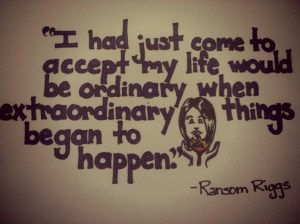 This book had me at hello — which is somewhat strange, since I’ve been staring at this title for a while now (it has been on the New York Times Best Sellers list for over 52 weeks)… the cover looked somewhat creepy and I wasn’t sure it’d be my cup of tea. But then I read the first line. Jacob seemed like an interesting character I would enjoy getting to know — I wanted to go along on this journey of self-discovery with him, and most importantly, I wanted his grandfather to not be crazy. With tales of girls who could float through the air or make fire appear from their palms, invisible boys, and worst of all, monsters… who wouldn’t doubt the poor old man’s sanity. A man whose magical tales of childhood had sparked a boy’s imagination and thirstfor adventure, suddenly just seemed frail and delusional — still, Jacob’s declaration,”We cling to our fairy tales until the price for believing them becomes too high,” feels like it goes deeper than just his grandfather’s stories… making him out to be a grandiose hero was a fairytale — the price (looking after him, defending him from his parents) became too high. Fortunately, Jacob was able to find his way to this strange loop of September 3rd… he met an extraordinary, if peculiar, group of people… he made a discovery after all. Thus, in the end, Jacob turns out to be more than a just teenage boy learning about his grandfather’s past, his realizations go beyond the peculiar children in Ms. Peregrine’s care, his observations are far greater than slightly creepy photographs in a box… “I used to dream about escaping my ordinary life, but my life was never ordinary. I had simply failed to notice how extraordinary it was. Yet […] I realized that leaving wouldn’t be like Ihad imagined, like casting off a weight. Their memory was something tangible and heavy, and I would carry it with me.” I must admit… I want to know what happens with this band of odd children and a bird. I think I’ll be reading Hollow City to see how Jake and his friends fare on their adventure.


 Doodles and Words